
gentle critiquing
some thoughts on giving feedback without being a jerk about it

A friend shared with me recently some feedback she received—valid points were made, but the delivery was…less than stellar. It got me thinking about critique in general and how hard it can be to be on the receiving end of overly harsh feedback, even from someone who does truly want to help. And then I started thinking about critique in general and how difficult it was to learn to do it in a way that doesn’t hurt someone’s feelings.
I’m a pretty blunt person. We can blame it on the New England of it all (Noah Kahan gets it), or the neurospicy brain, or being raised by a parent who proudly told me that “suck it up” was the family motto. Ultimately, it doesn’t matter where it comes from. I am who I am—but that’s not an excuse for being mean. I’ve always known that. What I had to learn was the threshold between the two, and that there is a point where bluntness isn’t kind or helpful.
Critique is a skill like any other. The more you work at it, the better you become. Giving critique (when asked for) to your fellow writers can be a great way to build community and strengthen your own craft. It tends to be easier to spot gaps or problems in someone else’s work simply because you’re not as close to it as your own. Sometimes in ways that feel painfully obvious…to you.
Have I given feedback that in hindsight was unnecessarily harsh? Absolutely. I’m not proud of it, but I try to keep it real in this newsletter, and that’s the truth. Usually it was either out of frustration or my own exhaustion or something going on in my life that stressed me out and I couldn’t really see in the moment how my words would come off, but that doesn’t make it okay. These days, I’m a lot more careful to not read for critique when I’m already in a bad mood or at the end of my rope.
If you’re an author, or any type of creative, you know that asking for feedback is often the emotional equivalent of stripping naked and asking someone to point out everything wrong with your body. In short, it sucks. It’s necessary, but it sucks. With that in mind, here are a few of my tips on how to be kind in your critiques:
OWN YOUR OWN SHIT
I’m starting with a hard one. Every author is coming at a story with their own perspective. Obvious, right? But from what I’ve seen, and even my own early critiques, I think it goes deeper than we tend to realize.
We all have tropes or plot lines that are Not For Me. Personally, I don’t love anything having to do with pregnancy or that heavily involves kids. That’s not to say I won’t read it—there are some fantastic single parent romances out there that I’ve enjoyed immensely (shout out to Maggie Gates & her delightful Dust Storm!).
But if someone asks me to critique their book, and it’s centered on pregnancy, it’s on me to be upfront about that. My preference is going to color my perspective to some degree (despite my best efforts to be objective), and I think it’s important to be transparent about it so that the author knows where I’m coming from.
Note: I am specifically talking about preferences. Tropes, plot lines, content that could be triggering, hell, even having an MMC that shares a name with a particularly horrible ex. But if you’re reading this and thinking, hmmm, I really hate books about [insert minority group here] and I should be upfront with the author about that, you absolutely should not. You should 1) not make your bigotry that author’s problem 2) unsubscribe from this newsletter and 3) go to therapy or otherwise figure out why you hate people arbitrarily who are just living their lives. (See? Blunt.)
The other part of owning your own shit? Being able to recognize the difference between “I would not have written it this way” and “this is bad craft”. Is this an easy distinction to make? Not always. I cringe thinking about some of the comments I sent other authors in my early days where I was definitely coming from the “I would never do it this way” place. The good news is that the more you think about it, and the more you improve your own craft, the easier it gets to recognize “this objectively doesn’t work” vs someone going about it in a way you wouldn’t.
COMPLIMENTS
I think most of us have heard of the compliment sandwich method, at least in passing. If you’ve somehow escaped that one, it’s where you give your feedback in a praise, critique, praise format. The idea here is to highlight positives to remind the person on the receiving end that there are good things about their work. Most of us need that reminder, especially when we’re trusting someone with work in its rawest form.
Be as specific as you can with your compliments. “It was great!” is nice to hear, if not particularly helpful. What made it great? A lot of writers are anxious about their work. I know some very successful writers who still have the exact same doubts I’ve had since before I sent my first query letter. Remind people what they’re good at before you point out what needs work.
It can be hard to remember specifics. My brain is a sieve these days thanks to the many demands I place on it, so what I’ve started doing is keeping a notes app of bullet points as I read. (I can’t take credit for this idea - my delightful friend and fellow 2026 debut Rachel Pologe introduced me to it when she read an early copy of Chase Me If You Can).
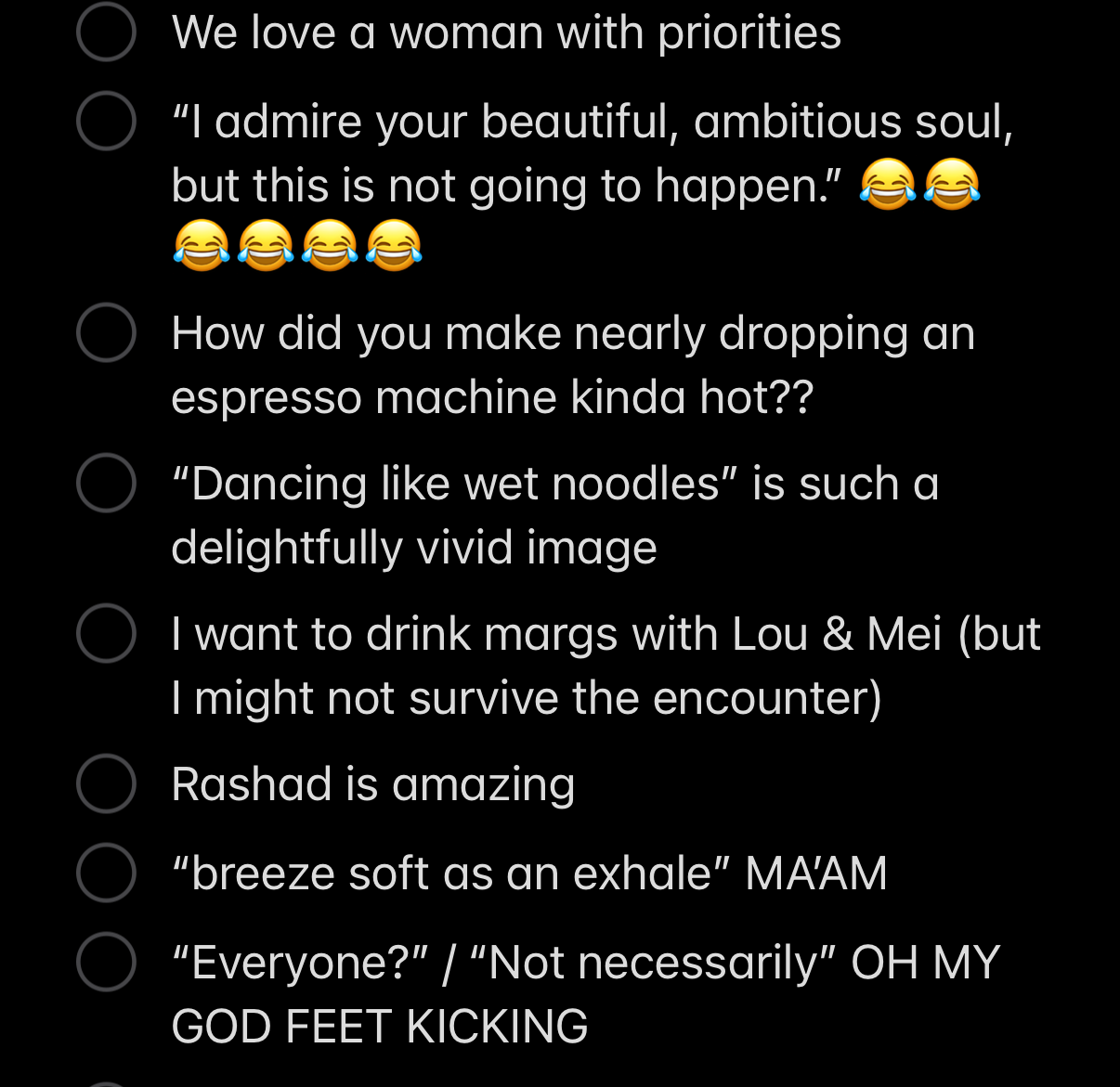
If it’s an author I know, I tend to take screenshots when I’m done and share them. (Please remember to always be strictly positive when crashing into DMs. Nobody, absolutely nobody, wants to get a surprise kick in the teeth in the form of critique they didn’t ask for when they’re just trying to have a little morning scroll with their coffee.) If it’s not someone I know well enough to hop into their DMs, my notes app is a little trail of breadcrumbs that help me remember, oh yeah, I was swooning over that first kiss, or this line of dialogue made me laugh so hard I couldn’t breathe.
TOUGH LOVE
This is another one that I think can get trotted out to excuse giving feedback that, while it might be “accurate” is delivered in an unkind fashion. Tough love, first and foremost, should be coming from a place of love.
Example time! Note to my friends who read this: this is an example only, I am not talking about any of your books I’ve recently read, ilysm. Telling someone “the first act drags and is boring” might be a factual statement. That doesn’t mean it’s something that author wants to hear (if you like this style of feedback, you do you.) It’s also a pretty general statement without any actionable feedback, so it can leave someone really discouraged and wondering where to even begin to fix the problem.
Just like compliments, be specific in your critique. Explain why you feel, to continue the example, the first act drags. Is it that the plot isn’t moving forward? Is it that there’s too much of X and not enough of Y? Are the characters just looping through the same argument three times? This not only takes some of the sting out of it because you’re not making a sweeping “this sucks” type statement, but it gives that author a jumping off point in their edits.
The other thing about being specific is that it can help an author figure out if their intentions are landing. Think about how sometimes a one star review can be the reason you buy a book. If someone is complaining they didn’t like it because there’s too much of a thing, and I personally love that thing, I can infer that the book probably just wasn’t for that reviewer but I could have a great time. For me, this happened with an early version of CMIYC where someone really didn’t like one of the characters. It was clear from the comments I got back that the character was going through something so far from this person’s lived experience that she couldn’t comprehend the choices that character makes—but, at least so far, the next dozen or so people to read the manuscript have had the complete opposite reaction. Thanks to that person’s specifics, I could easily take that piece of her feedback and separate it from her other valuable notes.
ASK QUESTIONS
Another way to soften criticism is to frame it through a question. “Why is this character behaving in this way?” can take a moment where you might be tempted to type “this behavior comes out of nowhere” and instead get the author thinking about why they made that choice. The fact that you’re asking the question is a big hint that something isn’t translating, and a lot of the time, an author will then be able to connect those dots and make the revision. Your job here isn’t to fix the problem for them. It’s simply to get them to see it and let them fix it in the way that serves them best.
A really good personal example of this happened recently to me. I’ve been working on drafting a book that I’ve now written, oh, five or six times. I’ve mentioned this before - the book I queried that got me my agent and eventually died on sub will now be the second book of my Berkley contract, albeit with a completely different storyline. I consider it the same overall book because the characters are largely the same, as are their core emotional arcs. Needless to say, because I’ve worked on this book is so many iterations, there’s a lot of information in my head to wade through as I try to make decisions about this version of this couple.
In a moment of despair, I sent my CP a voice note and rambled on for a bit about how I just couldn’t figure out how to fit this one aspect from the OG version into the book. It kept tripping me up, and it was making it impossible to make any meaningful forward progress. The voice note I got back boiled down to one central question: do you need that thing you’re trying to find a way to make work or is that just leftover from the old versions?
It sounds so simple now as I sit here typing this out. And yet, until she asked that question, it didn’t (and probably wouldn’t have) occurred to me that I just…don’t need that piece. While it was necessary in the original, with all the other changes I’ve made, that thing I thought needed to work didn’t actually need to be there at all.
Could my CP have just said, Heather, you don’t need it, get rid of it? Sure. Would it have probably taken me longer to accept that that’s what needed to happen if she hadn’t asked it as a question that forced me to immediately think about why I wanted to keep it in there? Also yes.
CHASE ME IF YOU CAN
There’s not much to say here at the moment because everything I want to yell about has to be a secret for a little bit longer. But I recently got to see an almost final version of my cover and I just about lost it. Like almost yelled HOLY SHIT on a day job call that, oops, was NOT on mute when I was checking my emails. I’m so excited about how the cover is turning out, and I’m even more excited to share it. For now, please enjoy this little teaser.
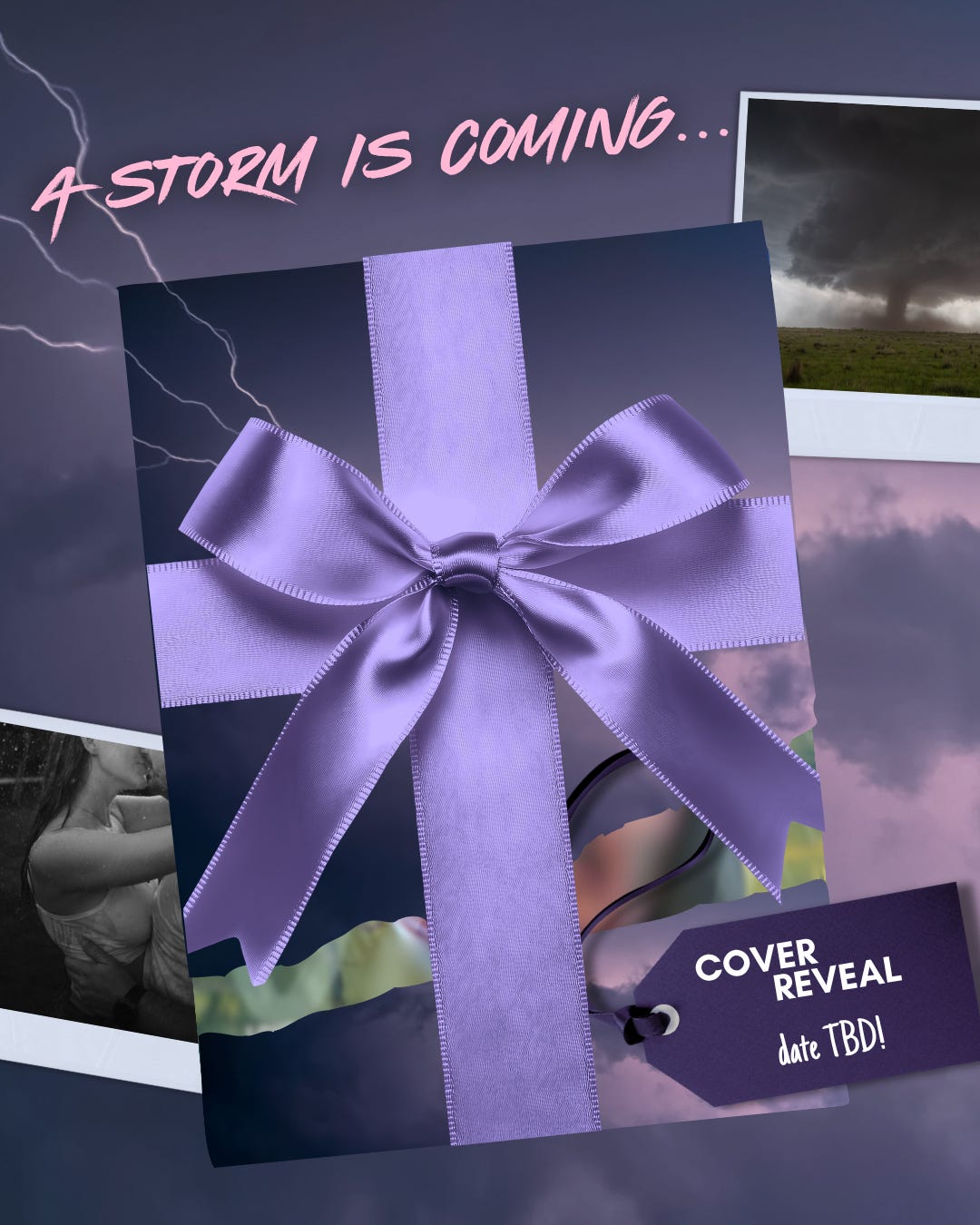
The same artist who did the cover is also currently working on some character art for me of one of my favorite scenes in CMIYC. I’m not sure when that will be ready to go out into the world, but you’ll see it here first when it’s ready!
OTHER AUTHORS’ BOOKS
Being in heavy drafting mode has meant my reading continues to be very slow but I had a great time with what I could squeeze in! (I checked my spreadsheet as I sat down to type this newsletter - 70k in 31 days - no wonder I’m so tired!)
Some Kind of Famous - Ava Wilder (out now!)
If you like small town romance that acknowledges wealth inequality, a messy and layered FMC, a cinnamon bun MMC, mountain vibes, and top notch secondary characters, this is the one for you!
Love in Plane Sight - Lauren Connolly (12.16.25)
Lauren is so freaking good at brother’s best friend. Love in Plane Sight is lighter than her trad debut, but still packed with incredible emotion, banter, and a grumpy/sunshine vibe that makes for some hilarious moments. This one also features a female pilot in training and great found family vibes!